


Ebook Guns, Germs, and Steel: The Fates of Human Societies, by Jared Diamond
This Guns, Germs, And Steel: The Fates Of Human Societies, By Jared Diamond is really correct for you as beginner user. The users will consistently start their reading routine with the preferred theme. They may rule out the author and also publisher that develop guide. This is why, this book Guns, Germs, And Steel: The Fates Of Human Societies, By Jared Diamond is truly right to read. Nonetheless, the concept that is given in this book Guns, Germs, And Steel: The Fates Of Human Societies, By Jared Diamond will certainly show you numerous points. You can begin to enjoy also reading up until completion of guide Guns, Germs, And Steel: The Fates Of Human Societies, By Jared Diamond.
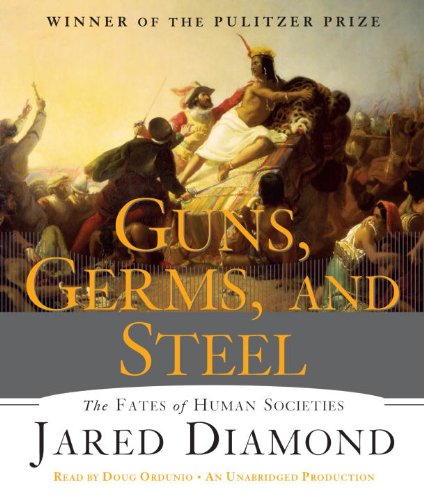
Guns, Germs, and Steel: The Fates of Human Societies, by Jared Diamond

Ebook Guns, Germs, and Steel: The Fates of Human Societies, by Jared Diamond
Guns, Germs, And Steel: The Fates Of Human Societies, By Jared Diamond. In undertaking this life, numerous individuals always aim to do and also obtain the best. New expertise, encounter, lesson, and everything that can enhance the life will certainly be done. However, many individuals sometimes feel confused to obtain those points. Feeling the restricted of experience and resources to be far better is one of the lacks to possess. Nevertheless, there is a quite straightforward point that can be done. This is what your educator always manoeuvres you to do this one. Yeah, reading is the response. Reviewing an e-book as this Guns, Germs, And Steel: The Fates Of Human Societies, By Jared Diamond as well as other referrals could enrich your life top quality. Exactly how can it be?
The method to get this publication Guns, Germs, And Steel: The Fates Of Human Societies, By Jared Diamond is quite easy. You may not go for some locations and invest the moment to only find guide Guns, Germs, And Steel: The Fates Of Human Societies, By Jared Diamond Actually, you may not consistently get the book as you agree. Yet below, just by search as well as find Guns, Germs, And Steel: The Fates Of Human Societies, By Jared Diamond, you can obtain the lists of the books that you really anticipate. Sometimes, there are lots of books that are revealed. Those publications naturally will astonish you as this Guns, Germs, And Steel: The Fates Of Human Societies, By Jared Diamond collection.
Are you curious about primarily books Guns, Germs, And Steel: The Fates Of Human Societies, By Jared Diamond If you are still puzzled on which one of the book Guns, Germs, And Steel: The Fates Of Human Societies, By Jared Diamond that ought to be purchased, it is your time to not this site to search for. Today, you will certainly need this Guns, Germs, And Steel: The Fates Of Human Societies, By Jared Diamond as one of the most referred publication as well as many required book as sources, in other time, you could enjoy for some other publications. It will rely on your willing needs. But, we always suggest that books Guns, Germs, And Steel: The Fates Of Human Societies, By Jared Diamond can be an excellent infestation for your life.
Also we talk about the books Guns, Germs, And Steel: The Fates Of Human Societies, By Jared Diamond; you may not find the published books right here. A lot of collections are offered in soft documents. It will specifically offer you much more advantages. Why? The initial is that you may not have to bring the book everywhere by satisfying the bag with this Guns, Germs, And Steel: The Fates Of Human Societies, By Jared Diamond It is for the book remains in soft file, so you could save it in device. Then, you could open the gizmo all over and also check out guide correctly. Those are some couple of benefits that can be got. So, take all benefits of getting this soft file book Guns, Germs, And Steel: The Fates Of Human Societies, By Jared Diamond in this site by downloading in link supplied.
Why did Eurasians conquer, displace, or decimate Native Americans, Australians, and Africans, instead of the reverse? Evolutionary biologist Jared Diamond stunningly dismantles racially based theories of human history by revealing the environmental factors actually responsible for history’s broadest patterns.
The story begins 13,000 years ago, when Stone Age hunter-gatherers constituted the entire human population. Around that time, the paths of development of human societies on different continents began to diverge greatly. Early domestication of wild plants and animals in the Fertile Crescent, China, Mesoamerica, the Andes, and other areas gave peoples of those regions a head start. Only societies that advanced beyond the hunter-gatherer stage acquired a potential for developing writing, technology, government, and organized religions—as well as those nasty germs and potent weapons of war. It was those societies, that expanded to new homelands at the expense of other peoples. The most familiar examples involve the conquest of non-European peoples by Europeans in the last 500 years, beginning with voyages in search of precious metals and spices, and often leading to invasion of native lands and decimation of native inhabitants.
- Sales Rank: #141410 in Books
- Published on: 2011-06-07
- Released on: 2011-06-07
- Formats: Audiobook, CD, Unabridged
- Original language: English
- Number of items: 13
- Dimensions: 5.86" h x 1.62" w x 5.05" l, .82 pounds
- Running time: 990 minutes
- Binding: Audio CD
Amazon.com Review
Explaining what William McNeill called The Rise of the West has become the central problem in the study of global history. In Guns, Germs, and Steel Jared Diamond presents the biologist's answer: geography, demography, and ecological happenstance. Diamond evenhandedly reviews human history on every continent since the Ice Age at a rate that emphasizes only the broadest movements of peoples and ideas. Yet his survey is binocular: one eye has the rather distant vision of the evolutionary biologist, while the other eye--and his heart--belongs to the people of New Guinea, where he has done field work for more than 30 years.
From Library Journal
Most of this work deals with non-Europeans, but Diamond's thesis sheds light on why Western civilization became hegemonic: "History followed different courses for different peoples because of differences among peoples' environments, not because of biological differences among peoples themselves." Those who domesticated plants and animals early got a head start on developing writing, government, technology, weapons of war, and immunity to deadly germs. (LJ 2/15/97)
Copyright 1999 Reed Business Information, Inc.
From Kirkus Reviews
MacArthur fellow and UCLA evolutionary biologist Diamond (The Third Chimpanzee, 1992, etc.) takes as his theme no less than the rise of human civilizations. On the whole this is an impressive achievement, with nods to the historians, anthropologists, and others who have laid the groundwork. Diamond tells us that the impetus for the book came from a native New Guinea friend, Yali, who asked him, ``Why is it that you white people developed so much cargo and brought it to New Guinea, but we black people had little cargo of our own?'' The long and short of it, says Diamond, is biogeography. It just so happened that 13,000 years ago, with the ending of the last Ice Age, there was an area of the world better endowed with the flora and fauna that would lead to the take-off toward civilization: that valley of the Tigris and Euphrates rivers we now call the Fertile Crescent. There were found the wild stocks that became domesticated crops of wheat and barley. Flax was available for the development of cloth. There was an abundance of large mammals that could be domesticated: sheep, goats, cattle. Once agriculture is born and animals domesticated, a kind of positive feedback drives the growth toward civilization. People settle down; food surpluses can be stored so population grows. And with it comes a division of labor, the rise of an elite class, the codification of rules, and language. It happened, too, in China, and later in Mesoamerica. But the New World was not nearly as abundant in the good stuff. And like Africa, it is oriented North and South, resulting in different climates, which make the diffusion of agriculture and animals problematic. While you have heard many of these arguments before, Diamond has brought them together convincingly. The prose is not brilliant and there are apologies and redundancies that we could do without. But a fair answer to Yali's question this surely is, and gratifyingly, it makes clear that race has nothing to do with who does or does not develop cargo. (Book- of-the-Month Club/History Book Club/Quality Paperback Book Club selection) -- Copyright ©1997, Kirkus Associates, LP. All rights reserved.
Most helpful customer reviews
67 of 72 people found the following review helpful.
The only persuasive explanation for the wealth gap between the West and the rest
By Mal Warwick
Two decades ago a UCLA geography professor named Jared Diamond published Guns, Germs, and Steel: The Fates of Human Societies. Diamond hypothesized that the arc of human history was dramatically shifted by geographic, environmental, biological, and other factors, resulting in the worldwide dominance of the leading industrial powers during the past 500 years. The book won a 1997 Pulitzer Prize and quickly became a New York Times bestseller.
Why is economic development so uneven around the world?
Diamond posed questions fundamental to the experience of the human race. “Why did wealth and power [among nations] become distributed as they now are, rather than in some other way?” “[W]hy did human development proceed at such different rates on different continents?” “[W]hy were Europeans, rather than Africans or Native Americans, the ones to end up with guns, the nastiest germs, and steel?” In his award-winning book, Diamond posited a “unified synthesis”—a unified field theory of history. Drawing from his wide-ranging knowledge of medicine, evolutionary biology, physiology, linguistics, and anthropology as well as geography, he surveyed the history of the past 13,000 years and identified plausible answers to the questions he had posed. In the process, he wrote what I consider to be the single most illuminating book on the history of the human race.
Academic critics howled
However, academic critics howled shortly after the publication of Guns, Germs, and Steel:
They referred to supposed errors in geography and history, which I find largely pointless. For example, geographers complained that Diamond referred to Eurasia as a single continent rather than separately to Asia, North Africa, and Europe. That’s nitpicking, as far as I’m concerned. And many of these “errors” could simply be differences of opinion. Academics are unbearably dogmatic and dismissive of those who reject their pet theories.
Some accused him of racism, although he rejected racist explanations early, forcefully, and often. That criticism is not only unsupported by Diamond’s book, it’s insulting to the reader.
The most common and far-reaching complaint was that Diamond had succumbed to the heresy of “environmental determinism.” Understandably, Diamond grounded his argument in geographic and environmental factors—but he repeatedly cited numerous other influences as well. Ultimately, of course, everything we humans do, and everything we’ve done in the millions of years since our ancestors first climbed out of the trees, has been environmentally determined.
There were complaints that Diamond had overlooked the contrast between temperate and tropical zones (he didn’t) and that he had only explained what happened 500 years ago but not subsequently (untrue). It might appear that at least some of Diamond’s critics never read the book.
However, the most aggravating criticism was that he had ignored the motives that led the industrial nations to undertake colonialism and imperialism on a broad scale. Diamond addressed only the means that enabled the colonial powers to dominate, not the reasons why they chose to do so. To my mind, that’s no error. He didn’t pretend to explain colonialism and imperialism, merely to describe how it had become possible.
Is it possible that most of these academic critics were simply bitter that Diamond hadn’t cited their own specialized research?
The roots of academic criticism
Though the critics undoubtedly uncovered a misplaced fact or unwarranted conclusion here and there through the book, the errors were exceedingly minor in the context of Diamond’s expansive hypothesis. It should be clear to any dispassionate reader that the academic reaction stemmed, above all, from narrow-mindedness and jealousy. The world of academia today is atomized. Specialties, sub-specialties, and sub-sub-specialties abound. It’s not unusual for a scholar to build a career on the study of a single obscure question that, when answered, will be of interest to virtually nobody. Interdisciplinary studies are frowned upon in most academic circles. Generalists are regarded as “not serious.” And scholars who write popular books, must less bestsellers, can expect a chilly reception from their peers.
A wealth of meaning behind the title
To understand where the academic critics went wrong, it’s useful to look at what Diamond signified by his title, Guns, Germs, and Steel. Early in his book, he dwells on the confrontation between the Spanish conquistador Francisco Pizarro and the Inca god-king Atahuallpa. “The immediate reasons for Pizarro’s success included military technology based on guns, steel weapons [such as swords and daggers], and horses; infectious diseases endemic in Eurasia; European maritime technology; the centralized political organization of European states; and writing. The title of this book will serve as shorthand for those proximate factors.”
Diamond’s argument in a nutshell
In a Prologue, Diamond poses the question at the heart of this book. He quotes a friend in what is now Papua New Guinea from a conversation in 1972, when he was studying bird evolution there: “‘Why is it that you white people developed so much cargo [goods] and brought it to New Guinea, but we black people had little cargo of our own?'” To answer the question, Diamond begins his story around the year 11,000 BCE, when the last Ice Age was drawing to a close and human beings were beginning to form villages in a few places around the world. It’s unclear whether the formation of villages preceded the deliberate cultivation and production of food, or vice versa. However, regardless of the sequence, that shift from hunter-gatherer society to agriculturally based settlements set in motion the course of events that have led to the “civilization” in which we live.
Diamond argues, convincingly, that the much greater availability of domesticable plants and large animals in Eurasia than in sub-Saharan Africa and the Americas. Furthermore, he explains that the east-west orientation of Eurasia from the Bering Strait to the Atlantic Ocean made it possible for the development of agriculture and animal husbandry to spread quickly to distant lands. By contrast, the north-south orientation of the Americas and sub-Saharan Africa—and the presence of barriers such as the Sahara Desert, the Panamanian Isthmus, and the deserts of northern Mexico and southwestern United States—impeded the spread of these (and, later, other) new technologies to the extremities of those continents. The advent of food production enabled the development of ever-larger settlements. This, in turn, spelled the emergence of labor specialization and eventually the growth of empires as well as the appearance and spread of communicable diseases contracted from domesticated animals. Those differences in historical development eventually led to the “guns, germs, and steel” that made Eurasian dominance possible—and dictated the huge differences in economic development between what today we call East and West.
Guns, Germs, and Steel is crammed with facts and densely written. It doesn’t make for light reading. But if you have any interest in understanding how the world came to be as it is, you’ll find this book highly rewarding.
1 of 1 people found the following review helpful.
It gave me a better understanding about the world history in more scientific perspectives
By Liu Yang
Guns, Germs and Steel tops the books I have ever read regarding the evolution and competition of the human race. It gave me a better understanding about the world history in more scientific perspectives. It also cleared some of my doubts and misunderstandings towards different cultures.
Although I read in original English took more time than reading in my mother tongue, it is really worth it!
6 of 7 people found the following review helpful.
My Brain Hurts
By Franklin the Mouse
If you decide to tackle "Guns, Germs, and Steel," it would be advantageous to read chunks of the book or at least a full chapter instead of a few pages at a time. Despite a few personal stories involving the people of New Guinea, Mr. Diamond's work is very academic in its delivery. It's too bad the guy doesn't have the writing flair of Bill Bryson. Don't get me wrong, it's an interesting read, but I wonder how many people who bought this thing actually read it from cover to cover? There are portions where he lists a variety of examples to support his argument, but the stuff started evolving into so much information-overload gibberish. I challenge anyone to remember all the island names and whatnot in the chapter entitled "Speedboat to Polynesia." If you can, then congratulations! You have the big brain.
The author culls information from a variety of scientific disciplines to support his very convincing argument. Mr. Diamond blows a huge whole through the racist attitude that some races are superior to others. He also unintentionally makes a mockery, without mentioning them, of the monumentally nutty Ken Ham's Creation Museum and his delusional ilk. Mr. Diamond stresses that "Guns, Germs, and Steel" is a broad overview of how people, plants, animals, and, most importantly, societies evolved. He does not claim that everything between the covers of this thing is etched in stone and clearly stresses when certain information is inconclusive.
The Pulitzer-Prize-Winning work is exactly how I'd expect a professor to give a credible presentation. The chapters build upon the previous ones to give the reader a clear picture of how the world's societies evolved. "Guns, Germs, and Steel" is one of those works that give us layman lots to ponder. It was well worth slogging through the thing, but for your normal, everyday Dick or Jane, this isn't like reading a... ehhh... Dick-and-Jane book. It felt like homework.
Guns, Germs, and Steel: The Fates of Human Societies, by Jared Diamond PDF
Guns, Germs, and Steel: The Fates of Human Societies, by Jared Diamond EPub
Guns, Germs, and Steel: The Fates of Human Societies, by Jared Diamond Doc
Guns, Germs, and Steel: The Fates of Human Societies, by Jared Diamond iBooks
Guns, Germs, and Steel: The Fates of Human Societies, by Jared Diamond rtf
Guns, Germs, and Steel: The Fates of Human Societies, by Jared Diamond Mobipocket
Guns, Germs, and Steel: The Fates of Human Societies, by Jared Diamond Kindle
0 komentar:
Posting Komentar